|
History Books The Corinda Library building, originally known as the School of Arts was built in 1895. The building served as a community hub and was refurbished as a library by Brisbane City Council in 1966. The book designs symbolize the library’s historic knowledge, with key historical dates inscribed on the spines. |
 |
|
Gossia gonoclada Gossia gonoclada, or Angle-stemmed Myrtle, is an endangered plant species found in the Corinda area. The species is native only to the Moreton Bay Area. Corinda hosts Brisbane’s largest population of Angle-stemmed Myrtle trees. |
 |
|
Flood Lines The Corinda area is a floodplain which brings challenges and opportunities. From fertile lands to resilient community spirit, there are 2 sides to this river. This design outlines the Oxley Creek catchment and reaches the limits of flood maps that shaped the area. |
 |
|
Black cockatoo The Glossy Black Cockatoo is a native species of the Corinda area and classed as an endangered and vulnerable species. Its red tail inspires the design. The colour reflects both the danger it faces and its striking plumage. The black cockatoo prepares to take flight, escaping danger. It soars into a sunset sky, symbolising conservation efforts. |
 |
|
Building communities The Corinda sawmill, ‘Brisbane Timbers Ltd.’, was founded by David Lahey in 1911. It became an important local economic institution. The mills were integral to many significant projects, including the construction of Brisbane's trams. The patterns represent the way in which raw timber logs are milled, and the building of the surrounding community. |
 |
|
Crop lands The Corinda area was used as farmland from the mid 1800s through to the mid 1900s. This design represents the life cycle of corn, a major crop grown in the area. The area’s fertile soil supports corn growth in 4 seasons, aided by year-round rain and sunshine. |
 |
|
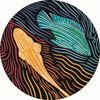
Two Fish Two of the local fish species, Flathead and Tilapia, are represented in this design. The image symbolically captures the intersection of Oxley Creek into the Brisbane River. Tilapia is the most common fish in Oxley Creek. Flathead are among the most common in the Brisbane River. Intersecting currents reveal contrast. Each fish is framed by its own flow lines between the waterways. |
 |
|
Train Tracks This design represents both the historical and modern significance of the train tracks to the Corinda area. The woodcut style of illustration uses various intersecting patterned forms to contrast the differing materials of steel, wood, and stone. |
 |
|
Belly Glider Five of the six Australian species of glider are found in the Oxley Creek Catchment. This design represents the distinctive folds of skin that are found on the bellies of gliders. The belly symbolizes vulnerability and highlights the need for vigilant conservation and protection of native species. |
 |
|
Interwoven History This design comprises an interwoven pattern from the architraves of the historical Francis Lookout structure known as a ‘lychgate’. This landmark was erected in 1902 by women’s suffrage activist Angela Francis as a memorial for her family. Two interwoven lines represent Angela and her husband Arthur. A clover symbolizes each of their 5 children. |
 |
|
Wetlands aspect This design shows a view of the grasslands around the Oxley Creek Catchment and the waterway and the fauna therein. The Black Swan represents abundant birdlife in the area, including over 170 species like Spotless Crake and White-headed Pigeon. |
 |
|
War and peace The Corinda Library building, once The Corinda School of Arts, is among Corinda’s most significant sites. It offered community comfort during both World Wars and hosted peace and memorial celebrations afterward. Colours, symbols, and lines depict the transition from wartime strife to peacetime calm in this design. The central space represents the building as a key place of community gathering and support. |
 |
Corinda Library
Explore Corinda Library’s features, facilities and services. Attend an event at the library.

Contact details and opening hours
641 Oxley Road, Corinda Qld 4075 07 3407 7701Monday: Closed
Tuesday: 10am–5pm
Wednesday: 10am–5pm
Thursday: 10am–5pm
Friday: 10am–5pm
Saturday: 9am–4pm
Sunday: Closed
Closed on public holidays
Facilities and features
Creative lighting at the library
Near the library entrance ramp, a creative lighting gobo projector displays artworks reflecting Corinda's history, flora, fauna, and culture.
Location and parking
641 Oxley Road, Corinda Qld 4075
Where to park
Parking is available on surrounding streets.